Showing posts with label Exhibitions. Show all posts

Friday, 13 May 2016

Pompeii’s Vitality and Tragedy Unearthed in Atmospheric Exhibit

at Montreal Museum of Fine Arts


reviewed by Nancy Snipper

Vesuvius leaves its lasting legacy
 On August 25th, 79 A.D. Mount Vesuvius erupted, (Pliny the Younger states two different  dates), the thriving port city of one of Italy’s most prosperous of Roman towns suffered an irreversible catastrophe, and along with this cultural mecca, Herculean and Stabiae.
The exhibit sets the tone immediately. Before entering the first of nine rooms, a black and white still in a projected image of the summit has its moving element; spewing smoke appears. A far more dramatic display of events reiterates this scene on a large scale that clocks in the four eruptions over a 24-hour period – the last of which is the final Tsunami-like covering of the entire town. This film, with some sound effects, mesmerizes viewers; and most would only recall this as the story of Pompeii, had not the other eight rooms brought to life the exuberant daily life and artistic zenith of the town and its inhabitants.  
How clever that the exhibit builds up the bustling, dynamic reality that resonated within Pompeii’s walls! Its houses, shops, outdoor theatres, markets and more are brought to life; there are even background sounds that vividly enhance the visual aspects in the 220 artifacts that viewers can appreciate as they travel back in time.
Historical information is outlined regarding Roman rule and Pompeii’s subsequent uprising against the colonizing yoke that failed. An earthquake in 62 A.D. did nothing to shake the spirited people of Pompeii; it took 17 years to rebuild most of their beloved town. Little did they suspect nor surmise what would soon ensue.
One of the most telling examples of the people was the amazing amount of bakeries – 40 in all – that sprung up everywhere. Some houses even sold bread from the open door. Paintings depict this aspect of food, but ominously displayed near portable kilns, stoves, cooking utensils and more is a half-round loaf of carbonized bread.
Weights in iron and brass, oil lamps, coins dating from 41 to 70 A.D. are on display. Gold, silver and brass constitute their material. Carpenter tools fascinate as do the plumbing outlet faucets and more. Aged with patina, I thought these were remarkably telling of the city’s sophistication in taking care of hygiene and water.
I saw vintage raw axe heads, rusted nails and strange vertical measuring instruments. Amidst the major statues in marble found in various indoor gardens, tables and ornaments in glass, I beheld a dozen pieces of gold jewelry that dazzled in design, brightness and colour.
The four distinct stages of painting, including the masonry technique and trempe d’oeil, a plethora of wall panels and paintings and many scenes in relief along with tiny lares – gods in bronze housed on a shelf as protectors. Details in their art astound; they are priceless pieces of antiquity.
Tessserae – mosaic pieces that are assembled in figurative art, even a strigil, gladiator armour used in battle and more converge to show the diverse activities that travel the gamut from art to fighting – even dice games.
I was not persuaded that each piece was the original – especially in the perfectly smooth totally intact marble pieces, along with the frescoes that were obviously repaired; they were in too good condition to accept as untouched by restorers – all which should have been clarified in writing on the relevant plaque – along with the dates and provenance of many items were lacking. The audio guide surely explained more about each piece, but gallery exhibits usually provide vital written information to the viewer.
Finally, the second last room showed a film and several figures cast in positions of their last breath was unforgettably moving. Thanks to Giuseppe Fiorelli who carefully retrieved many of the dead, pulverized in ash and pumice, 1000 bodies of the 20,000 once very alive inhabitants have been recovered. He was able to get them out using a specific technique, employing casting, the human tragedy lives before our eyes. Overall, this exhibit is appealing, yet I would have liked more explanations of the making of a fresco and the repairing of so many pieces in the lab overseen by Professor Stefano Vanacore, director of the restoration.

View slideshow:


“Pompeii” continues until September 5th, 2016.
The Montreal Museum of Fine Arts is located at 1380 Rue Sherbrooke O, Montréal, QC H3G 1J5
The website is: http://mmfapompeii.com/


Friday, 3 May 2013

Peruvian Exhibition… a Golden History!


Montreal Museum of Fine Arts
 
                                                                      by Nancy Snipper

Titled Peru: Kingdoms of the Sun and Moon, this inspiring exhibition comprises 370 works of art: gold and silver ornaments, sculptures, textiles, pottery, paintings, litho and photos and more.  The astonishing collection of pre-Columbian treasures and masterpieces from the colonial era to Indigenism includes 100 pieces that have never traveled beyond Peru, and so it is highly important that we all get to view the stunning array of culture embodied in bold and exquisitely delicate works of intricate art. Rituals and non-secular objects come to life in12 different galleries. Amazing works from the Sipán culture in Mochica (100-800 AD), the Sicán in Lambayeque (750-1375) and the Chan Chan from Chimu (900-1476) prove to be stand-outs. The Spaniards led by Pissarro in 1545 brought Peru’s indigenous religion to its knees, and replaced it with a Catholic culture and the art that represents it is grandiose and on display as well. 
A wonderful projection of Machu Picchu introduces us to a country which has reclaimed it golden periods of a highly organized culture that embraces a spiritual identity based on dualism and the after-life.  
 
Machu Picchu was discovered in 1911 and more is said about its findings in the first section of the exhibition. The second focuses on the myths and ritual in the pre-Columbian era. Many objects in the galleries devoted to this topic revolve around human sacrifice. The knives used to sever the head are like double axes and big. Evidently, a severed head meant the returns of ancestors and the strengthening of the community which also had its own cult. It reached its apex with the Chimu culture of 900-176.  The provenance of many of the artefacts in the entire exhibit is the northern coast of Peru, with the Vice-Royal settlement happening more inland. 
The Inca culture which started in the mid-13th century and expanded it empire well into the 16th century created refined works of highly intricate art. Silver seemed to be used for feminine objects as this metal represented the moon goddess and her tears. Gold was used for masculine anecdotal art, and indeed the religious elite certainly reigned in Peru as did the appointed from royal blood line, The litter in the display is a staggering example of fine detailed work that marks Peru’s art from the beginnings to its modern day life. 
They say seeing is believing, and so below you will see photos from the exhibition whose crowning jewel is  the Mochica from La Mina. Measuring 28.5 x 4.5 cm, it was discovered during an illegal excavation of a tomb at La Mina in the Jequetepeque Valley which has been pillaged for one year starting in 1988. Called the Peruvian Mona Lisa, it   is a terrifying sea god. Intercepted in a London Gallery by Scotland Yard in 2004, this mesmerizing masterpiece was sent back to Peru in 2006. It is
 now on display in Lima, but you can see it in this exhibition in Montreal.  
Luis Alberto Peirano Falconi, Peruvian Minister of Culture, said “This ornament which has been removed from this place of permanent display in Lima for this exhibition represents at once a new appreciation of the country’s past, the fight against the illegal trafficking of cultural property and our Peruvian identity.”  
With its millennia-old culture, Peru is now recognized as one of the six cradles of civilisation. This exhibition transports you to this rich land of mystery, magnificence and magic. 
Peru: Kingdoms of the Sun and Moon runs until June 16th, 2013 at the Montreal Museum of Fine Arts. The website is http://www.mbam.qc.ca/peru/

.

Major works in the exhibition

Peru: Kingdoms of the Sun and the Moon
identity and conquest in the ancient, colonial and modern eras
 

       Mochica, north coast, possibly La Mina 
Forehead Ornament with Feline Head and Octopus Tentacles Ending in Catfish Heads 
100-800 A.D. Gold, chrysocolla, shells,  
28.5 x 41.4 x 4.5 cm    
Lima, Museo de la Nacion.          
Photo Daniel Giannoni


Mochica, North Coast, Earspool depicting a warrior (100- 800 A.D.)      
Gold, turquoise, wood, 9.2 x 9.2 cm Museo Tum bas Reales de Sipan, Lambayeque  
Photo: Joaqu fn Rubio   


Mochica, north coast, Pur Pur   
Bottle depicting a human figure below a bicephalous snake 100-800 A.D   
Painted ceramic 38 x 30.7 x 12 cm Museo Larco, Lima  
Photo© 2011 Joaquin Rubio  
 

Mochica, north coast, Sipan  
Figurine depicting a supernatural half-human, half-bird being 100-800 A.D.   
Copper 11.5 x 7.2 x 6.5 cm 
Museo de Sitio de Huaca Rajada Slpan S/T14-Cu- 77  
Photo © 2011 Joaquin Rubio     
              
Mochica, north coast, Sipan Ornament in the shape of a human head 100-800 A.D.
Gold, silver, lap!s lazuli 15.5 x 15.2 cm 
Museo Tum bas Reales de Sipan, Lambayeque MNTRS-37-INC-02  
Photo © 2011 Joaquin Rubio     
      
Lambayeque, north coast Tumi (ceremonial knife) 750-1375 A.D.   
Gold, silver, turquoise 36.2 cm 
The Metropolitan Museum of Art, Gift and Bequest of Alica K. Bache 
 © Image The Metropolitan Museum of Art/Art Resource, NY  
 

Chimu, North Coast 
Set of Head and Body Ornaments  
Late Intermediate Period (1000-1476 A.D.) Gold, silver and copper alloy, 
 46.6 x 21.9 cm Museo Larco, Lima   
Photo: Joaquin Rubio  
  
Lambayeque, North Coast Funerary mask 7S0-137S A.D.  
Gold, silver, amber, emerald 7 x 31 x S9 cm  
Museos "Oro del Peru" - "Armas del Mundo," Fundaci6n Miguel Mujica Gallo, Lima  


Lambayeque, North Coast, Back of Litter
(750 - 1375 A.D.)
Wood, silver, cinnabar, sulphurous copper and ammonia, shells, turquoise, feathers, 58 x 114 x 5 cm
Museo Oro del Peru, Lima
Photo: Joaquin Rubio


Lambayeque, north coast  
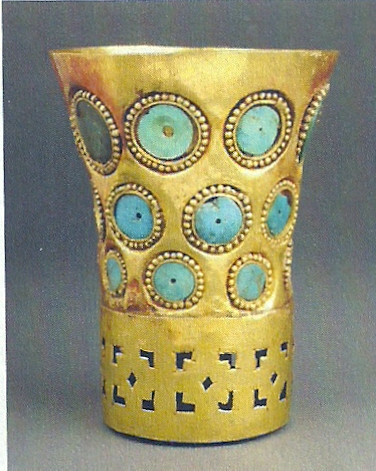
Drinking cup with rattle base and circular incrustations 750-1375 A.D. 
Gold, turquoise 13x10 cm   
Museos "Oro del Peru" - "Armas del Mundo", Fundaci6n Miguel Mujica Gallo, Lima M-00098   
Photo © 2011 Joaquin Rubio   
             
Lambayeque, north coast    
Gloves decorated with standing figures and geometric motifs 750-1375 A.D.    
Gold, turquoise,  15 x 55 cm; 12.8 x 53.5 cm
Museos "Oro del Peru" - "Armas del Mundo", Fundaci6n Miguel Mujica Gallo, Lima  
*and*          
 Lambayeque, north coast  
Drinking cup decorated with standing figures 750-1375 A.D.   
Gold, turquoise,  h.. 20 cm; d. 17 cm  
Museos "Oro del Peru" - "Armas del Mundo", 
Fundaci6n Miguel Mujica Gallo, Lima  
Photo Patricia Arana
               
Huari, south coast, possibly Rio Grande Valley Feathered hanging 700-1200 A.D.  
Cotton, feathers 65.8 x 216 cm  
The Montreal Museum of Fine Arts 1953. A.D  
Photo MMFA


Anonymous, Cuzco School Archangel Michael Triumphant 17th century   
Polychromed mahogany, gold, and silver leaves 198.1x115.8 x 83.8 cm  
New Orleans Museum of Art: Museum  
purchase and gift of Mr. and Mrs. Arthur Q. Davis and the Stern Fund   
  
Anonymous, Cuzco School, Nativity Chest, 18th c.   
Painted wood, polychrome plaster and maguey (agave), metal, 46.7 x lOS x 47.8 cm   
Museo Pedro de Osma, Lima
Photo: Joaquin Rubio    
       
Possibly Lima Anonymous, Eucharistic Urn in the shape of a Pelican (c.1750-1760) 
 Partially gilded silver, gemstones, 83 x 91 cm   
Monasterio Nuestra Senora del Prado, Lima     
         
 
Anonymous, Cuzco School, Young Virgin Spinning, 2nd third of the 18th c.   
Oil on canvas with gold leaf applications 112.7 x 80.6 cm. 
Museo Pedro de Osma, Lima  
Photo Joaquin Rubio 


Enrique Camino Brent (Lima 1909 - Lima 1960)  
La escalera roja, Cuzco [The Red Stairway, Cuzco] 1954 
Oil on canvas 59 x 59 cm   
Pinacoteca Municipal "Ignacio Merino" de la Municipalidad Metropolitana de Lima 
Photo : Joaquín Rubio    
          
 
Martin Chambi, Tristeza andina, La Raya (Andean sadness, La Raya),  
1933, Gelatin silver print, 10 x 15 cm.
Courtesy of Archivo Fotografico Martin Chambi, Cuzco 


Francisco Lasso (1823 - 1869)  
 Inhabitant of the Peruvian Highlands, 1855 
Oil on canvas 138 X 138 cm 
 Pinacoteca Municipal "Ignacio Merino" de la Municipalidad Metropolitana de Lima 
  Photo: Daniel Giannoni    
                
 
Leonor Vinatea Cantuarias, Postoras, 1944
Oil on canvas, 197 x 174 cm.
Museo de la Nacion, Lima.
Photo: Joaquin Rubio


Saturday, 12 January 2013

Once Upon a Time ... Impressionism:


Great French Paintings from the Clark


by Nancy Snipper


A stunning exhibition of 75 Impressionist masterpieces is lighting up four grand rooms inside the Montreal Museum of Fine Arts as part of its world tour.  The paintings have come from the Robert Sterling Clark collection – one of the rarest and finest collections of the genre in the world. “This selection focuses on the movement itself – its genesis, context and legacy – so we can illustrate its coherence,” said Nathalie Bondil, MMFA’s Director and Chief Curator who noted that “impressionism has become the best loved and most popular art movement of all time.” 
There is so much to say about the incredible paintings we can see at this intimate treasure as it provides lasting visual memories. The collection first introduces us to the Barbizon School of Impressionists who initiated plein aire painting in the Fontainebleau forest whose main village was Barbizon
Corot, Rousseau, Millet, Daumier, Boudin, Jongkind and Tryon took their ‘lighting cue’ from the paintings of Constable and Turner. I was struck by the stunning expanse of forest and water scenes. But Rousseau felt Millet’s peasants looked like actor dressed up to imitate these folk. In fact, what stands outs so wonderfully in text in the exhibition are the words said by Renoir as he casts comments that show his disdain for Parisian hypocrisy and pretension. As Impressionism caught on as a way to gain status, he made the comment that people are hanging investments on their walls, not paintings. 
 
Corot: Bathers of the Borromean Isles

Renoir: Self-portrait 1875

Like Corot and Manet, Renoir loved nature. He likened a tree to God – that for him a tree was far more than a combination of carbon elements. Pierre-Auguste Renoir’s ladies are so sensual, and real, we are not surprised when we read that Renoir felt only women makes this world tolerable.  

Renoir: Sleeping Girl


As we move from painting to painting, our eyes feast on so many genius talents whose brush strokes are as varied as the robes, flowers and skies and waves that they painted. Pissarro with his pointealesque innovation and Seurat with his wet on wet techniques, and let us not leave out Degas whose dancers and horses garnered great praise from Renoir who felt he was the only painter who knew how to capture movement.  
One of the great masterpieces hung near Bouguereau’s ‘Seated Nude’ and Tissot’s ‘Chrysanthemums’ were two gems by Boldini. The minute textured realism captured in the velvet robe and dress that his ladies wear as seen in ‘Young Woman Crocheting’ and ‘Crossing the Street’ are second to none in the exhibition. 

 Tissot: Chrysanthemums


 Boldini: Young Woman Crocheting
 
No doubt about it, these 18th and 19th-century masters of lighting, texture, mood and magnificent nature - captured in a still life or a seascape full of boats bobbing on waves - are immortal. Who else can paint onions and apples and make us what to pick them up off the canvas, but Renoir? Who else can paint peonies so magnificently that we can smell them as we stare at disbelief at their realism and beauty but Renoir? Monet, Toulouse-Lautrec, Gauguin, Gérôme, Morisot and more timeless talents are in this inspiring exhibition that is a must-see!   

Renoir: Apples in a Dish

Monet: Geese in the Brook

Degas: Dancers in the Classroom
 
 The exhibition continues until January 20th of this year. Next stop Tokyo (Mitsubishi Ichigogan Museum) followed by Kobe (Hyogo Prefectural Museum of Art). http://www.mbam.qc.ca/impressionnisme/HTML/en/index.html


Saturday, 5 February 2011

Parle-Moi D’Amour 2011/ Les Impatients

La treizième édition de l’exposition-encan « Parle-Moi D’Amour « ce présente le 5 Février des 14h jusqu’au 15 mars 2011. Les Impatients, créé en 1992, est un groupe de soutien pour les patients psychiatriques qui offres des ateliers artistique en but thérapeutique. Ce exposition-encan regroupe plus de 250 œuvres produit par Les Impatients a le but de recueillir des fonds pour permettre aux Impatients de poursuivre leur mission. L’adresse est Les Impatients, 100 Rue Sherbrooke Est, 4ieme Etage. Pour plus d’informations : 514-842-1043, http://www.impatients.ca/.  Heures d’ouvertures 10h a 17h Mardi au vendredi, 13h a 17h Samedi et Dimanche.

The thirteenth edition of the exhibition-auction "Talk to Me of Love" is being presented from February 5th from 2pm until March 15, 2011." The Impatients, created in 1992, is a support group for psychiatric patients that offer art workshops as a means of therapy. The exhibition-auction brings together more than 250 works produced by Les Impatients and has the purpose of raising funds to enable the organization to pursue its mission. The address is: Les Impatients, 100 Sherbrook Street East, 4th floor. For further information: 514-842-1043, www.impatients.ca.  Opening hours are from 10: 00 a.m. to 5pm on Tuesday to Friday and from 1om to 5pm on Saturdays and Sundays.