Showing posts with label Documentary - Social Commentary. Show all posts

Wednesday, 21 October 2015

3rd Annual "Au Contraire Film Festival"

(ACFF)


3e Festival du Film Au Contraire (FFAC)

From October 27 till 30, 2015 in the Maxwell Cummings Auditorium of the Montreal Museum of Fine Arts.
Du 27 au 30 Octobre 2015 dans l'Auditorium Maxwell-Cummings du Musée des Beaux-arts de Montréal.

For more info go to:  http://acff.ca/index.html 
Pour plus d’information aller a: http://acff.ca/french.html

This annual initiative showcases edgy thought provoking films that explore the issues in a way that will change one’s perspectives and help to erase the stigma of mental health. After each screening is a panel discussion involving film participants as well as consumers of mental health services, health professionals, movie directors and audience participation and discussion.  
Cette initiative annuelle met en vedette des films audacieux suscitant la réflexion qui explorent les questions d'une manière qui va changer ses perspectives et aider à effacer la stigmatisation de la santé mentale. Après chaque projection est une causerie réunissant des participants de films ainsi que les consommateurs de services de santé mentale, les professionnels de santé, les réalisateurs de films et la participation et la discussion du public.

Chronicle of Films seen / Chronique de Films vus:

Below find a run-down of all the films seen at this year’s festival. If time permits, a more elaborate critique (features only) will appear under the label “Film Box-Office.” They will be identified with the ACFF 2015 logo. Updates will appear on a frequent basis (hopefully once a day) so please visit frequently.
Un aperçu de tous les films vus au festival de cette année. Si le temps le permet, une critique plus élabore (long-métrages seulement) apparaîtra sous l’étiquette «Film Box-office.» Ils seront identifiés avec le logo du FFAC 2015. Les mises à jour apparaîtra fréquent (j’espère une fois par jour), donc veuillez visiter fréquemment.

After / Âpres:

During / Au cours du:


Touched with Fire / Touché par le Feu, United States / États-Unis 2015, 107m, Paul Dalio
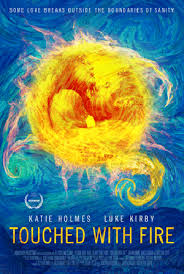
This film is inspired by the book Touched with Fire: Manic-Depressive Illness and the Artistic Temperament, written in 1996 by American clinical psychologist Kay Redfield Jamison. Carla Lucia, a published poet, becomes obsessed with trying to figure out what ‘triggered’ her ‘illness’; she has been diagnosed with bipolar disorder. She checks herself into the hospital to ‘investigate’ further. Marco is an underground rapper, who is also bipolar. He has gone off his medications and ends up being hospitalized as well. At first they are hostile and antagonistic towards each other, but their romance deepens. This tends to feed their respective manic states raising the concern of their parents and hospital staff.

Ce film est inspiré par le livre Touché par le Feu: Maladie Maniaco-dépressive et le Tempérament Artistique, écrite en 1996 par le psychologue clinique Américaine Kay Redfield Jamison. Carla Lucia, un poète publié, devient obsédé pour essayer de comprendre ce qu’a «déclenché» sa «maladie»; elle a été diagnostiquée avec un trouble bipolaire. Elle s’enregistre à l'hôpital pour «enquêter» plus loin. Marco est un rappeur underground, qui est aussi bipolaire. Il a arrêté de prendre ses médicaments et finit par être hospitalisé ainsi. Au début, ils sont hostiles et antagonistes l’un vers l'autre, mais leur romance approfondit. Cela tend à nourrir leurs états maniaques respectifs soulevant l'inquiétude de leurs parents et le personnel de l'hôpital.
[Exception made to 99-word rule / Exception faite au règle de 99 mots]  

Pressure, United States / États-Unis 2014, 2m, Lily Yu
Portraiture of the daily pressures faced by a teenage girl.
Portraiture des pressions quotidiennes auxquels une adolescente fait face.

Before / Avant :

A Short History of Madness / Une Courte Histoire de la Folie, Canada 2014, 27m, Isabelle Hayeur
This dance film, choreographed by Virginie Brunelle, explores the evolution of the treatment of mental illness from the late 19th century to the present. The choreography is evocative and clearly shows that no matter what treatment is used, whether institutionalized or not, the mentally ill will always be in solitude.  
  Ce film de danse, chorégraphie de Virginie Brunelle, explore l'évolution du traitement de la maladie mentale de la fin du 19ème siècle à nos jours. La chorégraphie est évocateur et montre clairement que peu importe le traitement utilisé, qu'elles soient institutionnalisées ou non, les malades mentaux sera toujours dans la solitude.   

Thursday, 20 June 2013

L’Appel de la Forêt…


A visual wonder with an important message!  

[Reviewed by Nancy Snipper] 

Director Pascal Sutra-Fourcade takes us on a journey into the astonishing forests of Madagascar, Cameroon, Eretria, Brazil and Australia. The great interviewer and lover of nature, Yann Arthus Bertrand meets up  with dedicated biologists, forest engineers and conservationists who have given up their lives to stop deforestation and innovate ways to make villages independent.  We see how lemurs are responsible for spreading seeds in the jungle to promote growth. We learn that Cameroon is involved with the illegal exporting of wood to France and China. We behold the amazing calcified rock forests whose sharp pinnacles reach high into the sky of Madagascar. These lunar-like foundations are actually calcified fossils that date back millions of years. 
But this documentary is a story about heroic people too. We meet Père Pedro who singlehandedly built a city for the poor in Madagascar, and most of the population lives in deprivation. Children follow him as if he were a piped piper. We meet a wonderful man who goes to schools and plays his guitar as he sings lyrics about nature and its value. The song is funny; its refrain is: ants are as important as humans. In Brazil, one brave Portuguese anthropologist is in charge of protecting over 50 indigenous aboriginal tribes who have never seen the White Man. He goes into the forest and sets up camp near the pygmies. They come to him. The scene that follows is hilarious as we see how they act towards him and his team.  In another scene we meet a rare Australian bird whose tail fans out over its head. It can produce over 100 sounds that imitate other birds. Two of the sounds resemble the closing clicking sound of a camera shutter and a police siren. Then we hear another sound – that of a bulldozer coming right into their habitat.
   
Trees are precious, and for everyone cut down, our own lives are threatened. It’s a fine balancing act; many poor villagers are being taught to preserve the forest, yet they need the wood for survival. I was most impressed by the Japanese American who began making mangrove forests in the water with the people of Eretria and planting tiny trees for the people in Eretria. It’s all about food and community.
Over and over again, we see villagers literally taking destiny into their own hands, shaping it in order to preserve their beloved and most magnificent forests that bless the world in a million ways. They are beautiful and we need them to survive – as this film so splendidly proves!  I refer you to the poetry section of this blog; look for my poem called, “Gatineau Trees”. Wherever they grow, trees are miraculous.  


(This film was viewed, compliments of Le SuperClub Videotron, 5000, rue Wellington, in Verdun,  Quebec.)  
(Ce film a été visionné, avec les compliments de Le SuperClub Videotron, 5000, rue Wellington, à Verdun, Québec.)


Sunday, 30 September 2012

Harry Belafonte and other Musicians give voice to activist causes to change the world


                                                                 by Nancy Snipper

 Most of us know Harry Belafonte as that amazing singer whose sensual swagger and sparkling smile gave a face to Calypso. But how many of us know that Belafonte was an activist who happened to become an artist (as he puts it). Early on in his career, he took munificent measures on and off stage to begin the process of empowering Blacks and rattling the White American elite whose political powers were second to none in the world. It was Belafonte who got Bobby Kennedy to travel to the South and witness first hand the plight of the “negro”.  The young senator, now on side with Dr. King was murdered shortly after that trip in 1968.
It was Belafonte, who was banned from celebrity bathrooms on the very nights he was bringing millions of dollars into Las Vegas during his sold-out performances there. In fact, all Black performers were forced to hole up in a nearby shanty hotel neighbourhood, so that they would remain out of sight. Belafonte was even banned from swimming in the pool of the hotel where he was performing. But, typically Belafonte defied the guards keeping watch on the hotel roof. He proudly plunged into the pool, whereupon several 'White' women left their lounge chairs to jump in to join him. The guards retreated inside.
Belafonte was Martin Luther King’s close friend. He worked tirelessly for him, even worshipped him to an extent. Wherever the great leader went, Belafonte stood beside him on one side and Cora King on the other. In fact, the singer risked his life to go down to Greenwood, Mississippi in 1964 with Sidney Poitier and thousands of dollars of hidden cash for the civil rights workers in that state.
Belafonte traveled into Biafra and South Africa where he began a youth college program in America for Africans, and was instrumental in getting Quincy Jones on board and others for the We Are the World project. For the past 60 years, this Day-o singer has traveled into the world’s hotspot where poverty and apathy have deadened his own people. Harry Belafonte has garnered as many awards for his humanitarian work as he has for his artistry.  His speaks daily on the phone to his “friend” Nelson Mandela.
I met this legendary activist/musician recently during an International Film Black Festival event. Now walking with a cane, his energy and eloquence are mesmerizing. Now in the twilight of his life, he was so candid in assessing his experiences which included reference to failures he feels he had, particularly as a father and husband.
Mr. Belafonte believes there is a collective failure happening in the world. “There is still so much work to be done in the world,” he said with intensity and passion. Now 85, he tells his life story directly into the camera in the film, “Sing Your Song”. In this remarkable film, he ties his singing into his personal journey as an activist.
Now when I listen to him sing, I no longer just see him as a singer, an actor and a handsome man.  He also said that good outweighs evil, but things have gone wrong in this world because we do not connect to our young people, that we create divisions that lead to multiple downfalls.
Hearing him speak, I realized that most artists are really activists hiding behind paint, words, music and dance. Each has his own cause: Buffy Saint Marie for first Nations people, Pete Seeger and Bob Dylan – iconic protest songwriters.
Think of Peter Paul and Mary and Joan Baez with whom I had the privilege to share a conversation several years ago at a private house party upon her return from Israel. She told me how wonderful it was to perform there, that the people really responded powerfully to her songs. She was thrilled but tired, I recall, but the implication from the gist of our chat was the concert was she felt it was an important concert, for she was singing to people who knew about suffering and resilience.
No doubt about it, Musicians who sing to bring awareness to global problems have a huge impact on our psyche, our values and our will to eradicate the woes of the world.

For article on the 8th Film Black Festival CLICK HERE / Pour l'article sur le 8e Festival Film Noir   CLIQUEZ ICI

Friday, 1 June 2012

The Whale / La Baleine by / par Suzanne Chisholm / Michael Parfit

The truth can often be more extraordinary than fiction as is evidenced in this touching and emotional documentary about a young killer whale (orca), nicknamed Luna, who found himself separated from his family and sought to fulfill his need for social contact by trying to interact with humans. This film could have been a powerful science fiction drama and the encounter with Luna has been compared to one with an extraterrestrial. Luna was only two-years-old when he found himself separated from his family in Nootka Sound, a fjord on the remote west coast of Vancouver Island.
The film adds credence to the concept that many animals are capable of complex actions requiring thought; they do not behave entirely by instinct and are capable of showing emotions. The point that we should treat others with respect and on equal levels is one of the film's most powerful messages. If one has any trace of humanity, this film should greatly change one's outlook on life in general, both human and animal and teach us the true value of life.

La vérité peut souvent être plus extraordinaire que la fiction comme en témoigne dans ce documentaire émouvant et émotionnel sur un jeune orque, surnommé Luna, qui se trouve séparé de sa famille et a cherché à satisfaire son besoin de contact social en essayant d'interagir avec les humains. 
Ce film aurait pu être un drame puissant de la science-fiction et la rencontre avec Luna a été comparée à celui avec un extraterrestre. Luna avait seulement deux ans lorsqu'il se retrouve séparé de sa famille à Nootka Sound, un fjord sur la côte ouest éloignée sur l'île de Vancouver. 
Le film ajoute foi à l'idée que de nombreux animaux sont en mesure d'actions complexes qui exige la pensé; ils ne se conduisent pas entièrement par l’instinct et sont capables de manifester des émotions. Ce que nous devons traiter les autres avec respect et à niveaux égaux, est l'un des messages le plus puissants du film. Si une personne à de trace d'humanité, ce film devrait considérablement changer son regard sur la vie en général, soit humaine ou animale et nous apprennent la vraie valeur de la vie.

Saturday, 12 May 2012

Ces Crimes Sans Honneur / Crimes without Honour par / by Raymonde Provencher


Selon L'ONG Human Rights Watch donne la définition suivante des meurtres pour l'honneur:
«Les crimes d'honneur sont des actes de violence, le plus souvent des meurtres, commis par les membres masculins d'une famille à l'encontre de ses membres féminins, lorsqu'ils sont perçus comme cause de déshonneur pour la famille tout entière. Une femme peut être la cible d'individus au sein de sa propre famille pour des motifs divers, comprenant : le refus de participer à un mariage arrangé, le refus des faveurs sexuelles, la tentative de divorce — que ce soit dans le cadre de la violence conjugale exercée par son mari ou dans un contexte avéré d'adultère. La simple interprétation selon laquelle son comportement a ‘déshonorer’ sa famille est suffisante pour enclencher une représailles.»
Human Rights Watch defines honor killings as follows:
“Honor killings are acts of vengeance, usually death, committed by male family members against female family members, who are held to have brought dishonor upon the family. A woman can be targeted by (individuals within) her family for a variety of reasons, including: refusing to enter into an arranged marriage, being the victim of a sexual assault, seeking a divorce—even from an abusive husband—or (allegedly) committing adultery. The mere perception that a woman has behaved in a way that ‘dishonors’ her family is sufficient to trigger an attack on her life.


Ces types de crimes ont été perpétrés contre les femmes depuis l'aube de l'humanité. À l'occasion, la victime serait masculine. Aujourd'hui puisque un bon nombre de ces crimes passer inaperçus, il est facile de croire qu'ils sont une chose du passé, surtout dans les nations occidentales, comme en Europe, Canada et les États-Unis. La réalité de la situation est que le nombre augmente, et cela est dû à l'immigration en provenance de cultures où «l'honneur familial» est si profondément enracinée dans leurs valeurs traditionnelles que lorsqu'un enfant «accepte» les valeurs culturelles occidentales, la réaction des parents est souvent désastreuse. L’affaire Shafia  au Canada et l’assassinat de Fadime Şahindal par son propre père en Suède sont de parfaits exemples.
Ce film essentiel et profondément émotionnel qui suscite la réflexion, explore et s’interroge sur ce qui peut être fait pour endiguer et on espère éradiquer ces actes de violence atroces. Nous suivons l'histoire de quatre personnes qui, avec courage et conviction, sont fermes en parlant et en dénoncant ces traditions criminelles et haineuses.

These types of crimes have been perpetrated mainly against women since the dawn of humanity. On occasion the victim would be male. Today since many of these crimes go unnoticed it is easy to believe that they are a thing of the past especially in the Western nations such as in Europe, Canada and the United States. The reality of the situation is that the numbers are increasing and this is due to immigration from cultures where ‘family honour’ is so deeply entrenched in their traditional values that when a child ‘accepts’  Western cultural values, the  reaction of the parent(s) is often disastrous. The Shafia murders in Canada and the slaying of Fadime Şahindal by her own father in Sweden are prime examples.
This thought-provoking, essential and deeply emotional film explores and enquires about what can be done to stem and hopefully eradicate these atrocious acts of violence. We follow the stories of four individuals who with courage and conviction stand firm by speaking out and denouncing these criminal and hateful traditions.


Friday, 13 April 2012

Intimidation par Lee Hirsch

               L'intimidation: Il est temps de prendre une position (Matters of Personal Interests)

Version Français de Bully (cultureplus)
Bullying: it’s time to take a stand (Matters of Personal Interests)

Related posts / Attestations relie:
http://smrcultureplus.blogspot.ca/2012/04/bully-by-lee-hirsch.html
http://mattersofpersonalinterests.blogspot.ca/2012/04/bullying-its-time-to-take-stand.html
http://mattersofpersonalinterests.blogspot.ca/2012/04/lintimidation-il-est-temps-de-prendre.html
Le dernier film «Bully (Intimidation)» réalisé par Lee Hirsch est un documentaire ou «le moment est venu de s’exprimer». C'est un film provocateur et très important sur un sujet qui est en train de crée beaucoup de tumulte dans le monde entier. L'intimidation est un problème universel qui touché un grand nombre. L'intimidation peut se produire dans les écoles, au travail et même sur l’Internet (cyber intimidation). Elle transcende toutes les frontières, y compris géographique, raciale, ethnique et statut sociale. Ainsi, il peut avoir un effet dévastateur sur ceux qui en ont été victimes. Elle a mené beaucoup à s'isoler de la société du à la terreur d'être intimidé. Certains se suicident (appelé bullycide); d'autres deviennent des tyrans eux même ou se déchaîne violemment, habituellement pars la vengeance. Les victimes ont tendance à être exclus de la société, incapables de s’intégré, tandis que le tyran est souvent une personne anxieux, il se sent qu’il doit «prouver» quelque chose. Au fond le tyran se sent menacée par sa victime.
L'intimidation existe depuis le début de l'homme mais aujourd'hui du à les progrès technologiques dans les communications, les effets peuvent être plus dévastateurs souvent due a l'affichage sur les réseaux sociaux tels que Facebook et You Tube.
Ce documentaire très important, qui, à mon avis, devrait être visionnée par tous (malheureusement il a reçu un classement de ‘R’ au États-Unis, qui signifie que l'auditoire auquel elle est principalement dirigée, les jeunes moins de 17 ans ne sera pas admit pour le voir), suit les histoires de cinq élevés du secondaires qui sont (ou on été) des victimes d'intimidation, les effets sur eux même et sur leurs familles. Il documente également les réactions des professeurs, administrateurs, la police, la communauté et la société dans son ensemble. Il est temps de résisté et de décrier cette forme de violence et de réaliser que le cliché «les enfants seront les enfants» est dépassé, usé et carrément dangereux. 

 Ajouté le 28 février 2018
 Blue Helix - Vidéo HD Officielle d'Anti-Social Butterfly

Les cinq histoires sont :
Alex 12 de Sioux City en Iowa, qui doit endurer les insultes, les malédictions et les menaces tout en voyageant dans le bus à et de l'école. Il dit à ses parents qu’ils sont ses amis et ils sont simplement «déconner» comme il est si désespéré pour s'intégrer.
Kelby 16 de Tuttle Oklahoma, qui, avec sa famille, a été traités comme un paria dans cette petite ville profondément dans la Bible Belt des États-Unis depuis qu’elle a admis qu’elle est gay. Elle a dû faire face à la haine non seulement de ses camarades de classe, mais aussi de ses professeurs. Ja'Meya 14 comté de Yazoo en Mississippi a dû endurer d'être harcelé chaque jour, le matin et l’après-midi sur le voyage de bus aller-retour de l'école d’une durée d’une heure. Le premier jour de septembre, elle avait eu assez. Ja'Meya, calme et modeste, a pris le pistolet de sa mère dans une tentative de faire peur a ceux qui la tourmentait. Elle a été en suite accusée de plusieurs d’infractions majeures.
David et Tina Long, comté de Murray en Géorgie, sont en deuil. Leur fils Tyler, âgé de 17 ans, s'est pendu après des années d’avoir endurer des comportements abusifs envers lui. Ils se sentent coupable à être incapables de le protéger et de colère envers le système scolaire qui a échoué lamentablement en lui offrant un refuge.
Après que Ty Smalley a l’âge de 11 ans s'est suicidé en raison de l'intimidation, ses parents, Kirk et Laura a lancé une organisation contre l'intimidation, appelée «Stand for the Silent
On a tous besoin de s'impliquer et de crier à haut voix «L'INTIMIDATION: IL FAUT C’ARRÊT».
Lee Hirsch